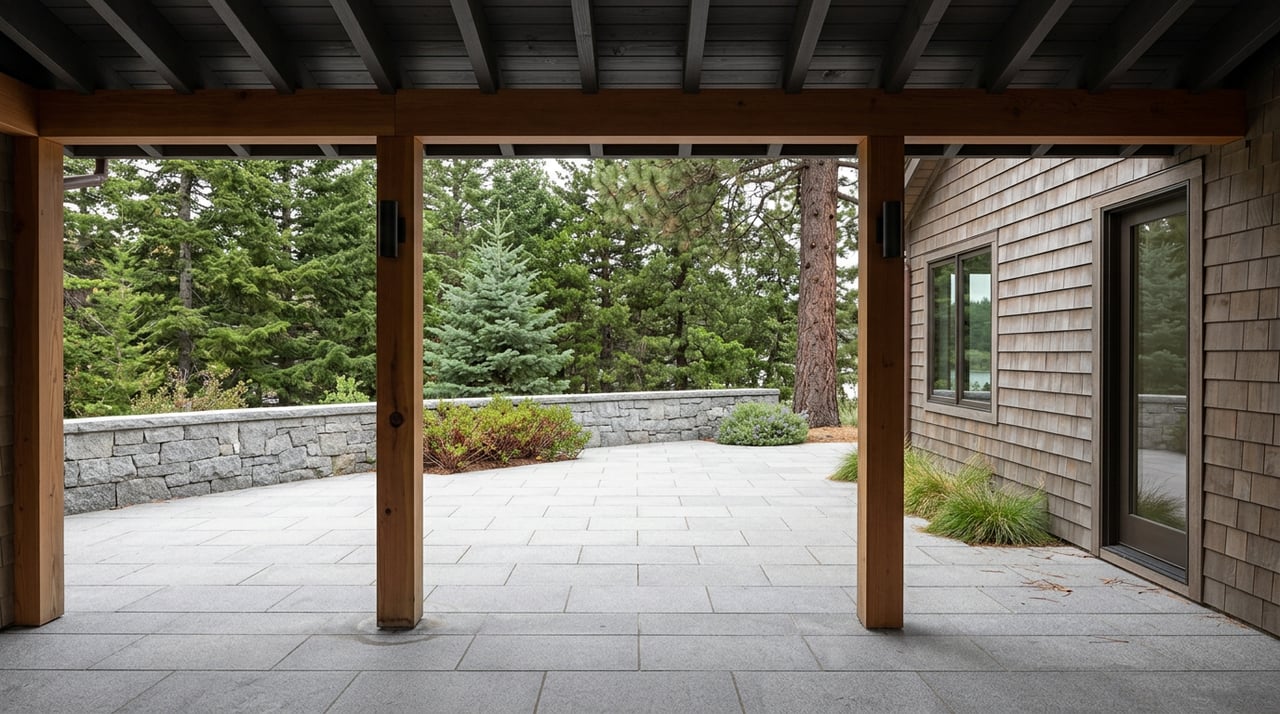
What Shapes the West Shore Lake Tahoe Real Estate Market
August 27, 2026
August 27, 2026
A buyer I was working with last spring got about halfway through the disclosure packet on a Homewood cabin before she called me, confused. Buried in the paperwork was a reference to the property's land coverage allocation and a note about "excess coverage." She asked if that meant the septic system needed work. It didn't. It meant something more consequential: the amount of house, deck, and driveway that lot is legally allowed to carry has already been decided by a regional agency, and it has almost nothing to do with the size of the parcel or what she could afford to build.
That distinction is the thing most buyers comparing West Shore Lake Tahoe against Tahoe City, Truckee, or the North Shore never quite grasp until they're already in escrow. Everyone understands that Tahoe inventory is tight. Fewer people understand that on the West Shore, tightness isn't just a function of demand outpacing supply. It's a hard regulatory ceiling that a seller's price tag and a buyer's budget can't move, and a three-year fight over the future of a single ski resort just showed how little that ceiling is going to change no matter how much capital shows up.
The Tahoe Regional Planning Agency governs how much impervious surface, meaning roofs, decks, driveways, and compacted ground, any parcel in the Basin can carry. This is measured as land coverage, and it's assigned parcel by parcel through one of two systems: the Bailey system for anything built before July 1, 1987, and the Individual Parcel Evaluation System, or IPES, for land developed after that date. TRPA's own guidance is direct about what this means in practice: the Bailey system prohibits new development entirely on the most sensitive parcels and restricts coverage on everything else, based on soil type and slope rather than lot size or ownership.
If a lot already sits at its allowed coverage and an owner wants to add a garage, expand a deck, or rebuild larger, the only way to do it is to acquire additional coverage from somewhere else. That "somewhere else" is a real, transactable market. The California Tahoe Conservancy runs a Land Bank Program that sells coverage and other development rights to owners who need them, and TRPA's code sets out three categories of rights that can move between parcels:
None of this is exotic paperwork. It's the actual mechanism that decides whether a West Shore lot can become a bigger home, a rebuilt cabin, or stay exactly as it is. A Conservancy transaction for coverage or restoration credit typically takes up to twelve weeks once final plans are submitted, and development rights transfers can take up to sixteen weeks and must close within a year. That timeline alone should change how a buyer thinks about a fixer-upper listing that looks like a bargain because of its lot size. The lot size was never the constraint.
Coverage scarcity isn't distributed evenly around the lake. Certain West Shore zones have run tighter on available transferable coverage than most other parts of the Basin, a pattern local reporting on the coverage system has documented for years and one TRPA itself has acknowledged as a byproduct of how coverage transfers are restricted to specific hydrologically related areas rather than being tradable Basin-wide. TRPA has been discussing a policy change in 2026 that would let coverage move more freely across those hydrologic boundaries, on the logic that runoff ends up in the same lake regardless of which shore it came from. That change is still under discussion, not adopted. A buyer weighing a West Shore purchase today should treat any future loosening as a possibility to watch, not a certainty to plan around.
This is the part that gets lost in generic "Tahoe is scarce" marketing copy. Scarcity here isn't a metaphor. It's an accounting system with a waiting list, and the West Shore has historically had less room on that ledger than other parts of the Basin.
If coverage math explains why West Shore inventory can't simply expand to meet demand, the fight over Homewood Mountain Resort explains why that constraint matters more now than it did a few years ago.
In 2022, JMA Ventures, the San Francisco firm that has owned Homewood for roughly two decades, brought in Discovery Land Company, the developer behind Montana's members-only Yellowstone Club, to redevelop the resort. The early version of that plan pointed toward a private club model, and West Shore residents organized fast. A group called Keep Homewood Public pushed back hard enough, alongside pressure from Placer County, that JMA and Discovery reversed course publicly in November 2023 and committed to keeping lift tickets and season passes available to anyone.
The reversal didn't end the process. It took until January 22, 2025 for the TRPA Governing Board to approve a scaled-back master plan after hundreds of residents attended the hearing and four hours of public comment. The approved plan cuts residential unit density by 45 percent compared to the original proposal, reduces building mass, and widens scenic view corridors. It also greenlit an eight-passenger gondola to replace the Madden Chair, an aging lift that was already about fifty years old when JMA first budgeted for its replacement in 2023. The approved plan also locks in enforceable language guaranteeing that Homewood's ski passes and day tickets will remain available for purchase by anyone, not just property owners or club members.
The master plan itself frames the goal as restoring Homewood as "a key gathering center for Lake Tahoe's West Shore," language that TRPA staff pointed to repeatedly during the approval process as the standard the resort will be held to going forward, with the agency retaining the authority to issue cease and desist orders if the commitment is violated.
Construction on the gondola was targeted to wrap by the 2025/2026 ski season, according to reporting at the time of approval.
Put the two threads together and the picture for a buyer looking at Homewood, Tahoma, Sunnyside, or anywhere along that stretch of West Lake Boulevard gets sharper. A significant capital investment is landing on the West Shore in the form of a new gondola and resort infrastructure. That investment is not going to translate into a meaningfully larger supply of homes around it, because the approved plan explicitly cut residential density rather than expanding it, and because the coverage system caps what any individual parcel nearby can add regardless of what the resort itself is doing. Demand pressure from a better-functioning mountain lands on a housing stock that has almost no structural ability to grow to meet it.
At the same time, the multi-year uncertainty over whether Homewood would go private, which was a real risk that shaped how some buyers and lenders viewed properties near the resort for the better part of three years, has been legally closed off by the enforceable access language in the approved master plan. That's a different kind of value than square footage or lot size, and it's one that only shows up if you followed the fight closely enough to know it happened.
Practically, that means a few things worth confirming before removing contingencies on any West Shore property:
Is Homewood Mountain Resort going private? No. The master plan TRPA approved in January 2025 includes enforceable language requiring that ski passes and day tickets remain available to the general public, not just club members or property owners.
Does the new gondola mean more homes are coming to the West Shore? Not in the way you might expect. The approved plan actually reduced planned residential density by 45 percent from the earlier version, so the investment is going into infrastructure and public amenities rather than a large new supply of housing.
If I buy a West Shore lot with room to build, can I count on that room? Only if coverage is actually available to transfer onto that parcel under TRPA's rules, or if the lot's base allowable coverage already supports what you want to build. Confirm the parcel's status before you assume anything about buildable square footage.
Understanding the coverage system and the Homewood outcome doesn't just make you a more informed buyer. It's the difference between reading a West Shore listing the way an out-of-area agent does and reading it the way someone who has watched this shoreline for decades does. If you're weighing a purchase here, or trying to figure out what a specific parcel's coverage status actually allows, I'd rather walk you through the real math now than have you discover it in a disclosure packet later. Reach out to Jeremy Jacobson and let's talk about what a given West Shore property can actually become, not just what it looks like today.
This article is general information, not legal, tax or financial advice. Consult a qualified professional about your situation.
Stay up to date on the latest real estate trends.
Etiam non quam lacus suspendisse faucibus interdum. Orci ac auctor augue mauris augue neque. Bibendum at varius vel pharetra. Viverra orci sagittis eu volutpat.